Showing posts with label Mantou/SD. Show all posts

Wednesday, 16 August 2017

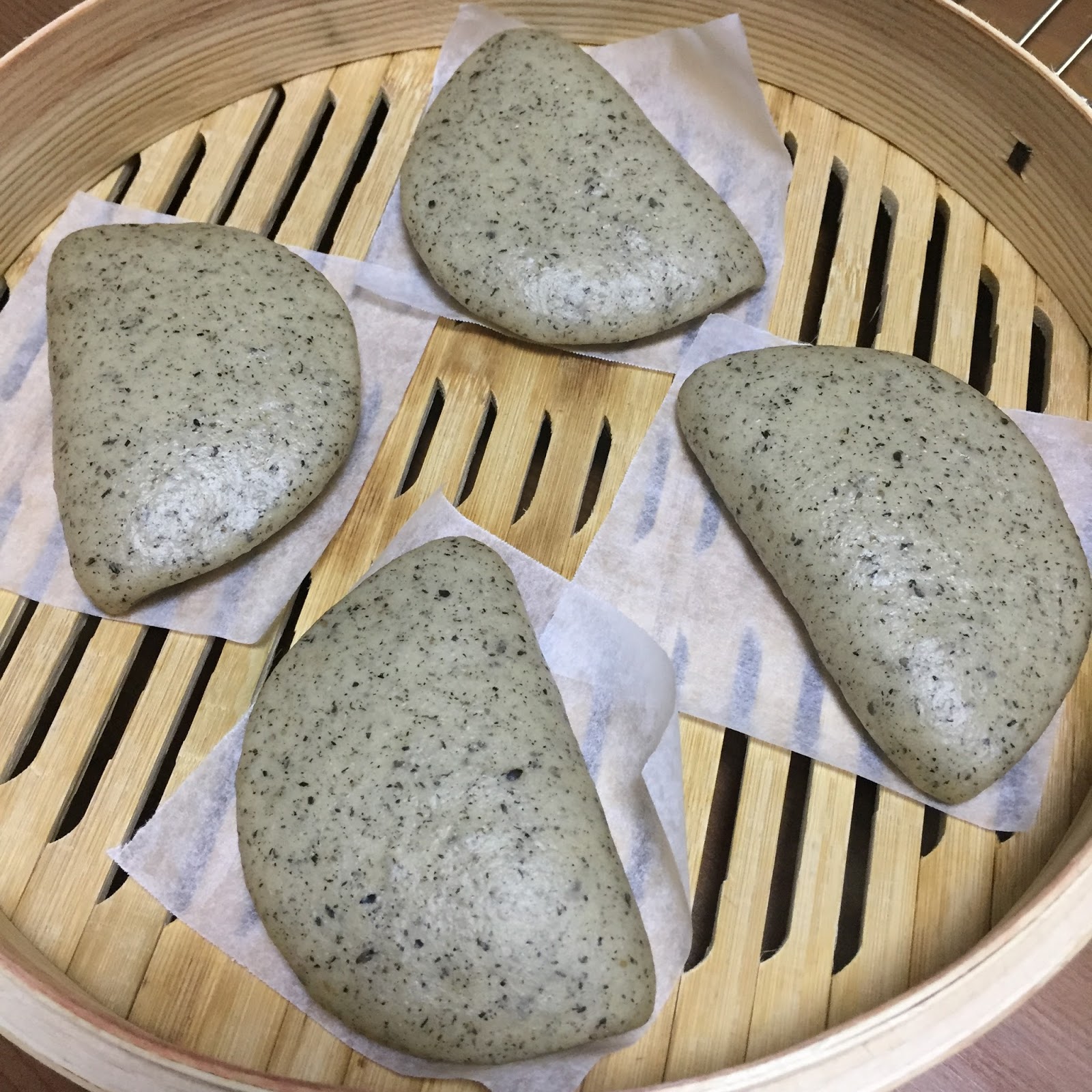
Sourdough Gua Bao 刈包 (chinese steamed bun)

The gua bao, also called "Taiwanese hamburgers", is a spin-off from mantou, Chinese steamed buns.  The steamed bun dough is rolled out and folded into half before steaming.  It is a Taiwanese street food, traditionally sandwiched with stewed fatty pork belly, pickled mustard greens or lettuce and coriander.  More novel ingredients such as fried chicken and fish are now added as fillings.

I love the versality of gua bao 刈包 and mainly used these chinese bread for breakfast.  They can be slathered with home-made bread spread or sandwiched with eggs, lettuce, cucumbers or tomatoes as my children's on-the-go breakfast.
This recipe uses sourdough starter as a leaven.  I also added atta flour, Indian finely milled wholemeal flour, and black sesame powder.  Both can be replaced with all purpose flour.


Ingredients (Makes 8)

  150g   All purpose flour
    40g   Atta flour (Indian wholemeal flour)
    10g   Black sesame powder
    80g   Active Sourdough starter
    88g   Milk
    10g   Sugar  (optional)
      2g   Oil of your choice (optional)


Instructions


1.    In the stand-mixer bowl, add all purpose flour, atta flour, black sesame powder, sourdough starter and milk.
2.    Using a wooden chopstick, stir to mix well.
3.    Add the oil.
4.    Use our hands to briefly knead the dough until a shaggy mass is formed. 
5.    Using the stand-mixer, starting at the lowest speed, knead the dough very briefly (5-10sec).
6.    Proceed to knead the dough on the next speed for 8minutes or until the dough is soft.
7.    Shape the dough into a nice ball.  Cover and rest it for 10min. to 15min.
8.    After 10min, lightly sprinkle the rolling mat with some plain flour.  Flatten the dough a little with our palm.
9.  Using the rolling pin, roll out the dough to form a vertically long rectangle.
10.  Fold 1/3 of the dough onto itself.
11.  Overlap the bottom 1/3 of the dough onto itself, forming a rectangle.
12.  Turn the dough 90°.
13.  Repeat steps 9-12, 3 to 5 times.   
14.  Using the rolling pin, flatten the dough to form a large rectangle.
15.  Roll the dough like making swiss roll to form a log.
16.  Divide and cut the log equally into 8 pieces.
17.  Roll each piece into a ball.  Cover and rest 10min to let the gluten relax.
18.  Take the first dough, flatten a little with our palm.  Roll it out and then turn it 90°.  Continue to roll it to form an oval shape.
19.  Prepare a small dish of oil.
20.  Brush half the oval with a thin layer of oil.  The thin layer of oil prevents the two halves of the dough from sticking after folding.
21.  Fold the dough into half and place it on a baking paper.
22.  Repeat steps 18-21 for the remaining dough balls.
23.  Fill up the steaming pot with 1/3 water.  Heat up this water to about 50°C-60°C.  
24.  Place the steamer tray, covered, on the steaming pot. 
25.  Proof for about 90-120min or until the dough feels light when lifted.
26.  Remove the steaming tray and bring the water in the steaming pot to a boil. 
27.  Put the steaming tray back on the steaming pot.  Steam on medium low flame for 12min.
28.  Turn off the flame and rest for 3min.
29.  Remove the cover slowly.  
30.  Voila!  The Sourdough Steamed Gua Bao is ready!


Thursday, 13 July 2017

Sourdough Tofu Oats Chinese Steamed Buns (Mantou)


The nutritious and healthy oatmeal is many people's morning go-to breakfast.  Consuming it helps to lower our "bad" cholesterol and keeps our heart healthy.  It has a low glycemic index and aids in regulating our blood sugar level.  Prepared correctly (to soak it overnight), oatmeal keeps us feeling full longer.

Traditionally, oats are soaked before cooking.  However, due to the modern hectic lifestyle, this practice is slowly forgotten.  Oats contain phytic acid, an anti-nutrient substance which binds to important minerals (such as copper, iron, zinc, etc.), inhibiting the body's absorption of those minerals.  Soaking the oats overnight with some acid, eg. lemon juice, apple cider vinegar, yogurt, whey, buttermilk or kefir, improves digestibility and in the process reduces the phytic acid present.  Without the soaking, some people may experience bloatedness or digestive issues after consuming oatmeal.  Thus, it is advisable to soak the oats for at least 8hours, or up to 24hours, before cooking them.


Further reading:  OVERNIGHT OATMEAL
                         How to Cook Oatmeal (the RIGHT way)

Ingredients

   30g   Organic old-fashioned rolled oats
  110g   Water
 1TBS   Plain yogurt

  54g     Silky Tofu
  64g     Active Sourdough starter
160g     Plain flour
  10g     Sugar  (add more if prefer to be sweeter)
    2g     Oil of your choice


Instructions


1.    In a glass bowl, add rolled oats, water and yogurt.  Give it a good stir.  Cover and let it stand overnight (at least 8hrs) at room temperature. 
2.    Pour the soaked oats into a mashed strainer.  Rinse and drain well.
3.    In the stand-mixer bowl, add drained oats, silky tofu, sourdough starter, plain flour and sugar.
4.    Using a pair of wooden chopsticks, stir to combine then use hands to mix until a shaggy mass is formed.
5.    Add in the oil and manually knead the dough briefly.
6.    Using the stand-mixer, starting at the lowest speed, knead the dough very briefly (5-10sec).
7.    Proceed to knead the dough on the next speed for 8minutes or until the dough is soft.
9.    Cover and rest the dough for 10min.
10.  After 10min, lightly sprinkle the rolling mat with some plain flour.  Flatten the dough a little with our hands.
11.  Using the rolling pin, roll out the dough to form a vertically long rectangle.
12.  Fold 1/3 of the dough onto itself.
13.  Overlap the bottom 1/3 of the dough onto itself, forming a rectangle.
14.  Turn the dough 90°.
15.  Repeat steps 11-14, 3 to 5 times.   
16.  Using the rolling pin, flatten the dough to form a large rectangle.
17.  Roll the dough like making swiss roll.
18.  Form a log dough.
19.  Divide and cut the log equally.  Put all the cut dough onto parchment papers and put them onto the steamer tray.
20.  Fill up the steaming pot with 1/3 water.  Heat up this water to about 50°C-60°C.  
21.  Place the steamer tray, covered, on the steaming pot. 
22.  Proof for about 90-120min or until the dough feels light when lifted.
23.  Remove the steaming tray and bring the water in the steaming pot to a boil. 
24.  Put the steaming tray back on the steaming pot.  Steam on medium low flame for 12min.
25.  Turn off the flame and rest for 3min.
26.  Remove the cover slowly.
27.  Voila!  The Sourdough Tofu Oats Chinese Steamed Buns is ready!
Sourdough Tofu Oats Chinese Steamed Buns (Mantou)

Sandwiched with egg and sliced cherry tomato

Tuesday, 20 June 2017

Dual Colour Yogurt Sourdough Chinese Steamed Buns (Mantou), 双色优格馒头

I love to use sourdough starter to replace commercial yeast.  Thus I used it to make chinese steamed buns, mantou (馒头).  To make the mantou more challenging, I replaced milk/water with yogurt.  I'm using the stand-mixer to knead the dough.

These steamed buns can be single or double proofed.  The surface of double-proofed steamed buns tends to develop more bubbles and thus aesthetically less appealing.  So I opted to proof the dough only once.
  

Ingredients  

72g       Active sourdough starter
90g       Plain yogurt
10g       Sugar  (add more if prefer to be sweeter)
180g     Plain flour
2g         Oil of your choice
5g         Curry powder

Instructions

1.    In the stand-mixer bowl, combine all the ingredients, except the oil and curry powder.
2.    Using a pair of wooden chopsticks, stir to mix all the ingredients until a shaggy mass is formed.

3.    Add in the oil and manually knead the dough briefly.
4.    Using the stand-mixer, starting at the lowest speed, knead the dough very briefly (5-10sec).
5.    Proceed to knead the dough on the next speed for 8minutes or until the dough is soft and smooth.


6.    Weigh the dough and divide into 2, making sure one dough is roughly 10g heavier than the other.
7.    Add the curry powder to the lighter dough.

8.    Manually knead the dough briefly (30sec) and finish kneading in the stand-mixer at speed 2 until the curry powder is well incorporated into the dough (about 3-4min).

9.   Cover and rest both the yellow dough and white dough for 10min.
10.  After 10min, lightly sprinkle the rolling mat with some plain flour.  Flatten the white dough a little.
11.  Using the rolling pin, roll out the dough to form a rectangle.
 12.  Fold 1/3 of the dough onto itself.
 13.  Overlap the bottom 1/3 of the dough onto itself, forming a rectangle.

14.   Turn the dough 90°.  Repeat steps 11-13, 3 to 5 times.
15.   Flatten the dough to form a large rectangle.
 16.   Take the yellow dough and repeat steps 11-15.  Roll out the yellow dough about the same size as the white dough.
 17.  Place the yellow dough over the white dough.  Rough the dough together like making swiss roll.
 18.  Form a log dough.
 19.  Cut the uneven ends of the log dough and place on parchment paper.  Divide and cut the remaining log equally.  Put all the cut dough onto parchment papers and put them onto the steamer tray.
 20.  Fill up the steaming pot with 1/3 water.  Heat up this water to about 50°C-60°C.  
21.  Place the steamer tray, covered, on the steaming pot. 
22.  Proof for about 90min-120min or until the dough feels light when lifted.

23.  Remove the steaming trays and bring the water in the steaming pot to a boil. 
24.  Put the steaming tray back on the steaming pot.  Steam on medium low flame for 10min.
25.  Turn off the flame and rest for 3min.
26.  Remove the cover slowly.
27.  Voila!  The dual colour yogurt chinese mantou is ready for devouring.